
Revision & Secondary Procedures
Revision is a normal part of the breast reconstruction journey. Most patients have a “touch-up” or “phase 2” procedure, where Dr. Haddock fine-tunes the aesthetic result.
Dr. Haddock also performs revision for patients who have had problems with a previous reconstruction. That can mean converting to an autologous flap (a reconstruction using your own tissue), or it can mean one of a number of other techniques.
Every revision is tailored to the individual situation.
Fat grafting
Dr. Haddock routinely offers fat grafting to his implant reconstruction patients. Fat is removed by liposuction from an area of unwanted fat, processed to remove extra tissue and fluid, and then injected around the implant.
The purpose is twofold: a better aesthetic result, and a more natural feel — the grafted fat adds a layer of your own soft tissue over the implant, and the thickness of that tissue is what determines how palpable an implant is. Dr. Haddock typically offers it at the time of implant exchange and at the time of nipple reconstruction.
Nipple reconstruction
Nipple reconstruction is often done at the same time as a revision.
For the best result Dr. Haddock recommends either a nipple reconstruction together with an areolar 3D tattoo, or at a minimum a 3D tattoo of the entire nipple and areola (the darker skin around the nipple). This is typically performed about three months after the size and shape of the breast are as desired.
If you are concerned about how much the reconstructed nipple will project, that can be tailored — within the limits of your own tissue.
Reshaping a flap
After a flap has settled, its shape can be refined. Liposuction can reduce fullness where it isn’t wanted and fat grafting can add it where it is. The small patch of skin that was used to monitor the flap can be removed or reduced, depending on the location. The new breast can often be tightened and lifted.
Matching the other breast
When only one breast is reconstructed, the other breast can be adjusted to match, with a lift (mastopexy), a reduction, or even an augmentation. This can sometimes be done at the time of the main reconstruction, but if not, it can be done at the time of the revision.
Refining the abdomen and belly button
The abdominal donor site can often be refined at the same time: liposuction of the upper abdomen and flanks, and potentially removing extra fullness at the ends of the scar. Dr. Haddock has pioneered a technique for creating a new belly button (neo-umbilical reconstruction that can be done at the time of nipple reconstruction or a later touch-up, often with a more natural aesthetic result than keeping the original belly button.
Converting to your own tissue
Some patients with an implant reconstruction, done here or elsewhere, later decide they would prefer a reconstruction using their own tissue. This is common when the breast has had radiation with the implants in place and/or when capsular contracture has developed. In a conversion the implants are removed and the breast is rebuilt with a flap, such as a DIEP (abdomen), PAP (back of the thigh) or LAP (lower back) flap. Which flap is right depends on each patient’s anatomy and history, including whether there has been radiation.
Implant revision surgery
Revision surgery most often means changing the implants — but the implant itself is frequently only part of what is done.
What a revision can involve
- Exchanging the implant for a different device.
- Surgery on the capsule. The body forms a layer of scar tissue around any implant. Depending on what that layer is doing, Dr. Haddock may release it (capsulotomy), remove it (capsulectomy), or stitch it to reshape the pocket the implant sits in (capsulorrhaphy).
- Acellular dermal matrix (ADM) — a sheet of processed donor tissue placed to support and reinforce the reconstruction.
- Rebuilding the inframammary fold, the crease under the breast. It is what sets where the breast sits on the chest, and a reconstruction can lose or blur it.
- Fat grafting, to soften edges and improve the soft-tissue cover over the device. This is the same technique described above, used here to refine an existing result.
Changing the pocket
A revision can also involve a pocket change — moving an implant from beneath the chest muscle (submuscular) to in front of it (prepectoral). This is most often done to get rid of animation deformity, where the breast moves or distorts when the chest muscle contracts, and it can also help with tightness and pain.
Before & After
An implant revision by Dr. Haddock — before on the left, after on the right.
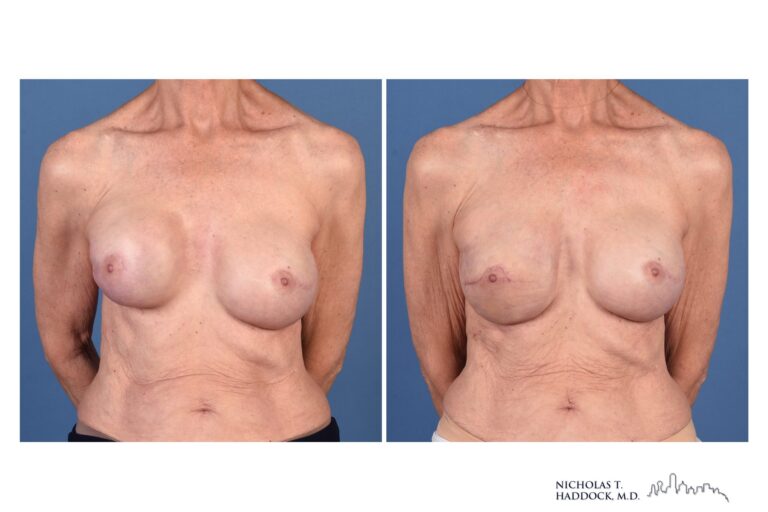
Individual results vary. Dr. Haddock posts a range of results to give patients a broad range of possible expectations. A large portion of the differences amongst results is a result of the patient anatomy and/or previous treatments. Photos are shared with each patient’s permission.
Considering a revision?
Dr. Haddock sees patients who are early in reconstruction and patients who already have a result they would like changed.
Request a Consultation