
Stacked & Four-Flap Breast Reconstruction
Using tissue from more than one donor site in a single operation, for patients who need more than any one site can give on its own.
Most breast reconstructions using your own tissue take that tissue from one place — the abdomen, the back of the thigh, or the lower back. Sometimes one site cannot supply what the breast needs. That happens most often when a breast is being rebuilt in a delayed operation (some time after the mastectomy), after radiation, or when a patient is slim enough that no single donor site holds enough tissue.
A stacked reconstruction uses two flaps to build one breast. A four-flap reconstruction uses four flaps to build two. The point is not simply more tissue. Drawing on two sites means less has to be taken from either one, so the dissection at each site can be more conservative — which limits what the operation costs you at the donor sites while still giving the breast the volume it needs.
Why natural-tissue reconstruction
- It is permanent. The reconstruction is built from your own living tissue, so once it has healed it is simply part of you — there is nothing to exchange or replace later.
- It looks and feels natural. The reconstructed breast has the softness and movement of the tissue it is made from, and it typically blends into the chest rather than sitting on it.
- It is living tissue with its own blood supply. That means it stays at body temperature — it does not turn cold when the weather does, the way an implant can.
- It changes with you. Gain weight and the reconstruction gains with you; lose weight and it does the same. It follows your body over time instead of staying fixed.
- It stays fat — it never becomes breast tissue. The tissue that is moved is skin and fat, and it remains skin and fat, so it does not change your risk of breast cancer.
These advantages are shared by every natural-tissue reconstruction Dr. Haddock performs — DIEP, PAP, and LAP alike. Which donor site is right for you is a separate question, decided together after examination and imaging.
The ways tissue can be combined
- Double (stacked) DIEP. Both sides of the abdomen used together to build a single breast.
- Double (stacked) PAP. Both thighs used together for a single breast, when the abdomen is unavailable or has already been used.
- Four-flap, DIEP and PAP. Bilateral abdominal flaps and bilateral thigh flaps in the same operation, to rebuild both breasts.
- Four-flap, DIEP and LAP. The abdomen combined with the lower back — a combination Dr. Haddock has published on.
- A flap combined with an implant. A single flap placed over an implant, so that the implant provides the volume a second flap otherwise would.
Which combination is right is decided together, after examination and imaging — the same way the choice between DIEP, PAP, and LAP is made for a single-site reconstruction.
Before & After
Six reconstructions using more than one donor site — before on the left, after on the right.
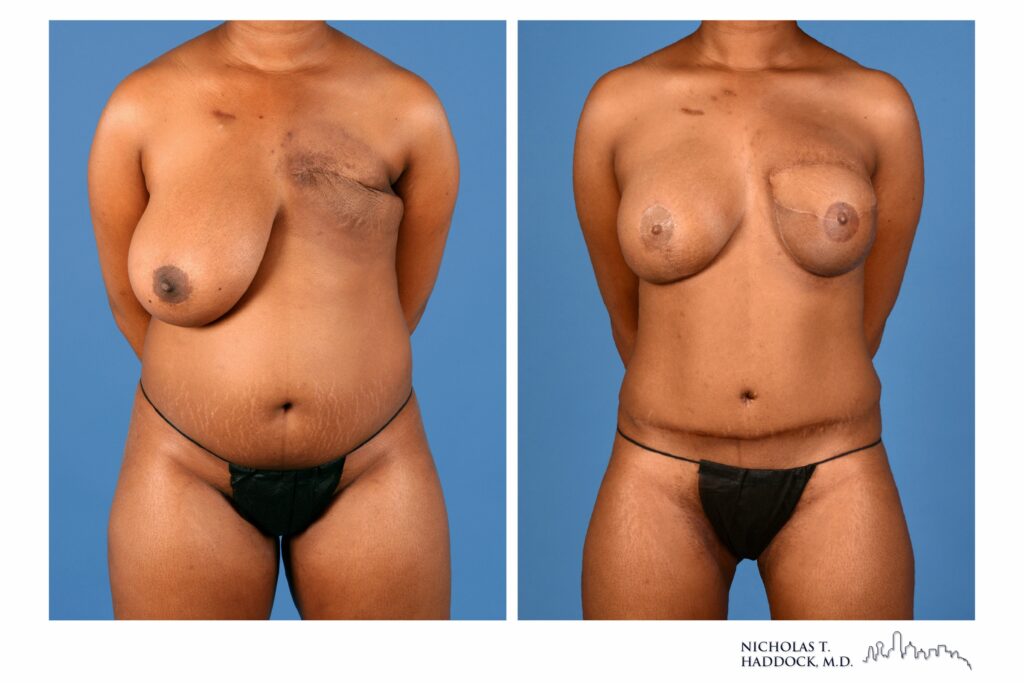
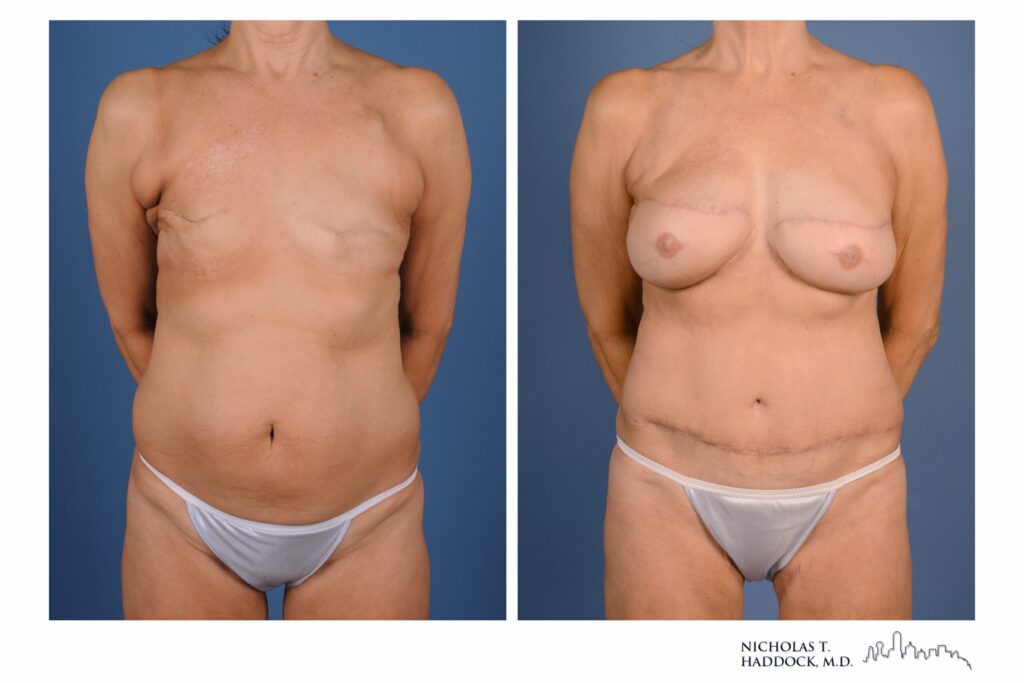
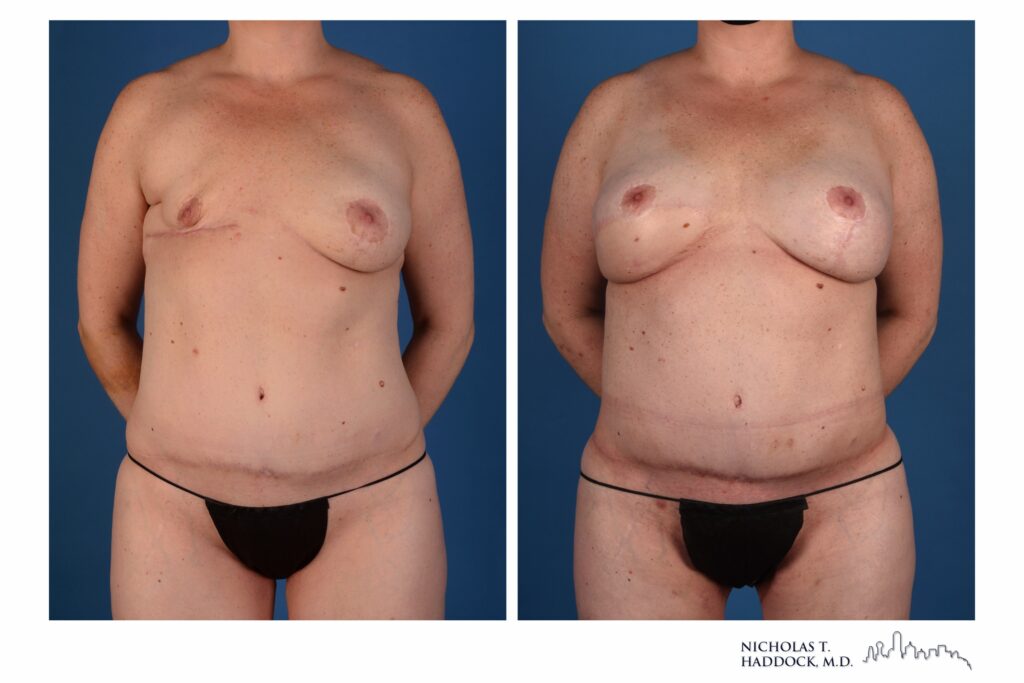
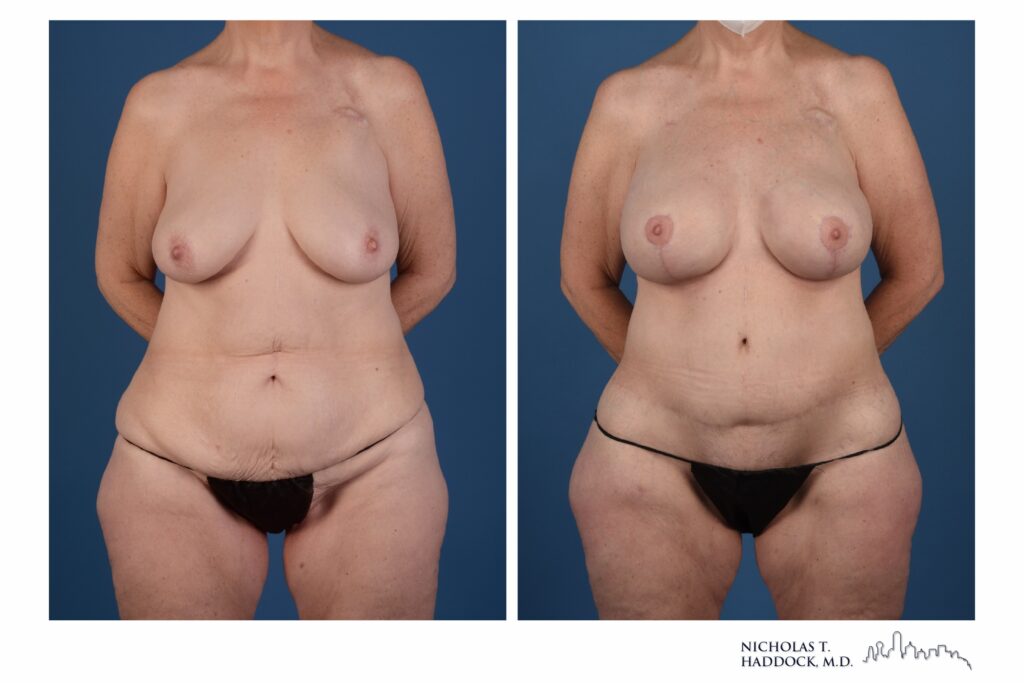
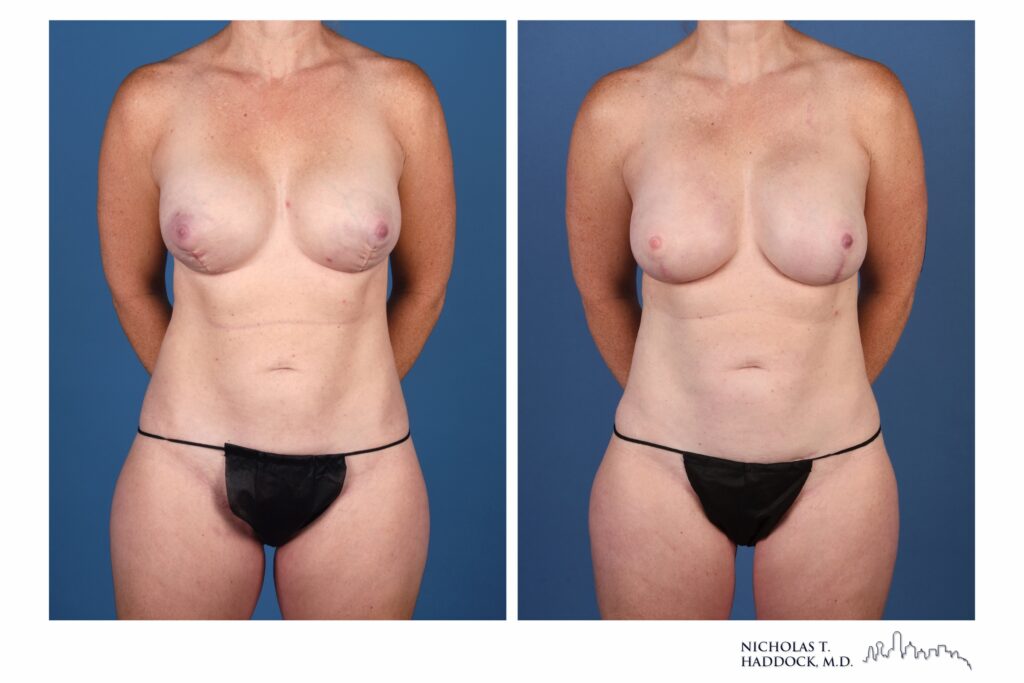
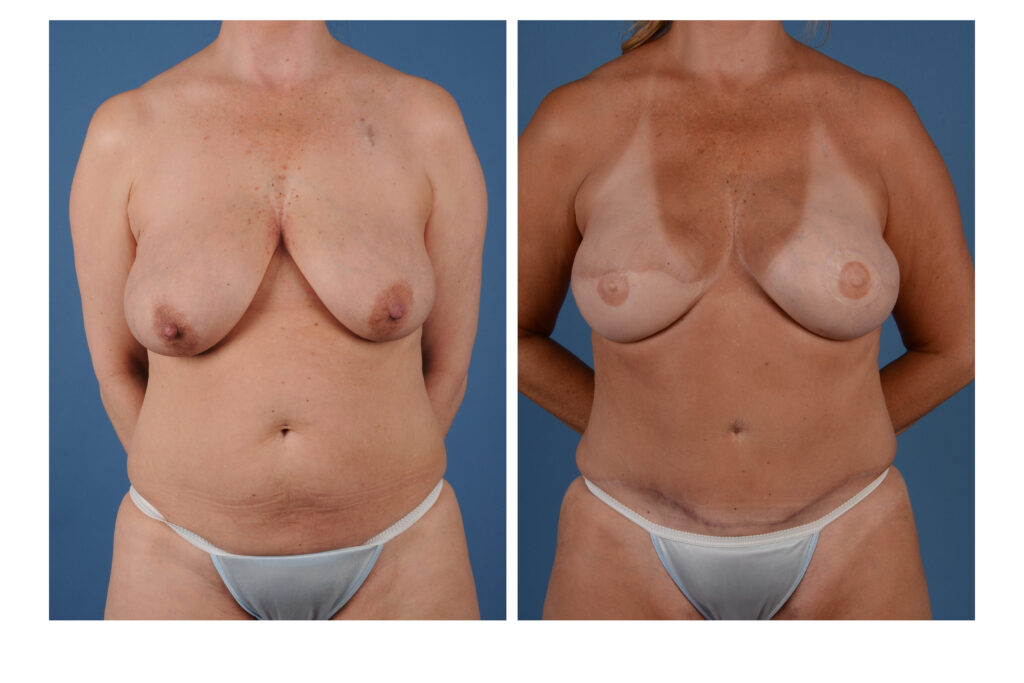
Individual results vary. Dr. Haddock posts a range of results to give patients a broad range of possible expectations. A large portion of the differences amongst results is a result of the patient anatomy and/or previous treatments. Photos are shared with each patient’s permission.
Stacked reconstruction, in more detail
Double (stacked) DIEP flaps
When one breast needs more skin and volume — often in delayed reconstruction or after radiation — both sides of the abdomen can be used together for a single breast.
When one thigh is not enough
Sometimes a single thigh will not supply the volume a breast needs. There are several ways forward, and the right one depends on your anatomy and your goals: both thighs can be used together for a single breast (a double, or stacked, PAP flap); if reconstruction is bilateral, the abdomen and both thighs can be used together in a four-flap operation; or a single PAP flap can be combined with an implant placed beneath it. Dr. Haddock has experience with all of these options, and will talk through the trade-offs of each with you before you decide.
Four-flap reconstruction
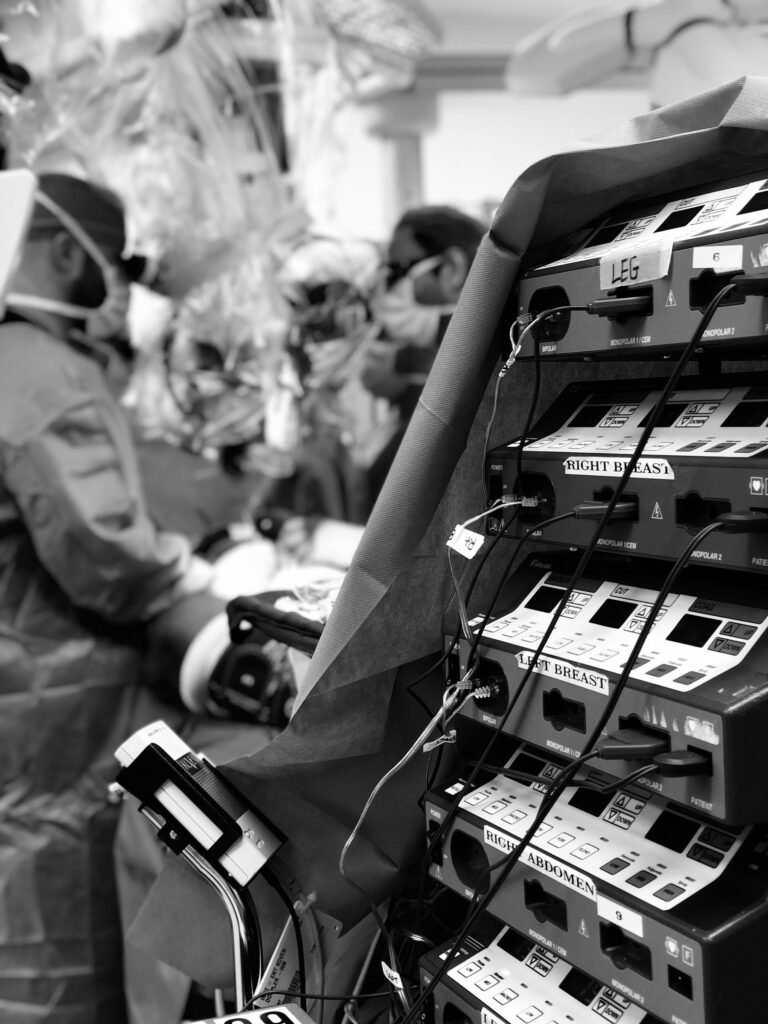
For patients in whom the abdomen or thighs alone won’t provide enough tissue, bilateral DIEP flaps and bilateral PAP (thigh) flaps can be performed at the same time. Using both donor sites avoids compromising the result and allows a more conservative surgery at each site. Dr. Haddock and his partner have one of the largest experiences with four-flap breast reconstruction in the world.
What it means for the donor sites
Using two sites rather than one does not mean twice as much surgery at each site. Because less tissue is needed from either site, the dissection at each can be more conservative — limiting problems at both the abdomen and the thigh compared with taking everything from a single place.
Printable instructions for your operation and your recovery. Most stacked reconstructions use abdominal and thigh tissue; use the sheet for each flap you’re having.
- DIEP flap instructionsPDF
- PAP flap instructionsPDF
- Drain carePDF
- Medications to avoidPDF
- Protein supplementationPDF
- Scar managementPDF
The work behind the operation
Stacked and four-flap reconstruction is a large part of Dr. Haddock’s academic work. These are peer-reviewed papers he has authored or co-authored on the technique, its outcomes, and how the flaps are connected.
- Haddock NT, Teotia SS. Modern Approaches to Alternative Flap-Based Breast Reconstruction: Stacked Flaps. Clin Plast Surg. 2023 Apr;50(2):325-335.
- Evgeniou E, Teotia SS, Haddock NT. Asymmetric Four Flap Breast Reconstruction with DIEP flaps and PAP flaps. Plast Reconstr Surg. 2022 Sep 15. Online ahead of print.
- Haddock NT, Dickey R, Perez K, Garza R, Liu Y, Teotia SS. BREAST-Q and Donor Site Comparison in Bilateral Stacked Autologous Breast Reconstruction. Plast Reconstr Surg Glob Open. 2022 Jul 25;10(7):e4413.
- Haddock NT, Kelling J, Teotia SS. Simultaneous Circumferential Body Lift and Four Flap Breast Reconstruction Utilizing Deep Inferior Epigastric Perforator and Lumbar Artery Perforator Flaps. Plast Reconstr Surg. 2021 Jun 1;147(6):936e-939e.
- Haddock NT, Suszynski TM, Teotia SS. Consecutive bilateral breast reconstruction using stacked abdominally-based and posterior thigh free flaps. Plast Reconstr Surg. 2020 Oct 29.
- Teotia SS, Dumestre DO, Jayaraman AP, Sanniec KJ, Haddock NT. Revisiting anastomosis to the retrograde internal mammary system in stacked free flap breast reconstruction: an algorithmic approach to recipient site selection. Plast Reconstr Surg. 2020 Apr;145(4):880-887.
- Haddock NT, Cho MJ, Gassman A, Teotia SS. Comparative Analysis of Single versus Stacked Free Flap Breast Reconstruction: A Single Center Experience. Plast Reconstr Surg. 2019 Jul;144(1):141e-143e.
- Haddock NT, Cho MJ, Gassman AA, Teotia SS. Stacked Profunda Artery Perforator Flap for Breast Reconstruction in Failed or Unavailable Deep Inferior Epigastric Perforator Flap. Plast Reconstr Surg. 2019 Mar;143(3):488e-494e.
Hear from patients
Three patients describe reconstruction using more than one donor site.
Considering a stacked or four-flap reconstruction?
Tell us a little about yourself and Dr. Haddock’s office will reach out to help you schedule a consultation.
Request a Consultation